

Commercial Christmas Tree Guide: Sizes, Ceiling Heights and Fire Safety

Short answer: Choose a tree about 2 to 3 feet shorter than the ceiling for standard lobbies, and leave more room in tall atriums for the topper and clear space below lights and sprinkler heads. Plan the width as carefully as the height. Indoors, commercial trees should be flame retardant with paperwork on hand for the fire marshal.
A commercial Christmas tree is the centerpiece of a lobby, atrium, storefront or town square. It is also a large object in a busy public space.
This guide covers sizing by ceiling height, footprint and clearance, indoor vs outdoor trees, fire safety, themes and the logistics of install and removal. Use it whether you manage an office tower, a hotel, a restaurant or a municipal plaza.
Tree height by ceiling height
Measure from the finished floor to the lowest thing above the tree spot. That might be a ceiling, a soffit, a light fixture or a sprinkler head. Then subtract room for the stand, the topper and clearance.
Ceiling height | Suggested tree height | Notes |
|---|---|---|
9 to 10 ft | 7 to 7.5 ft | Small office or restaurant entry |
12 ft | 9 to 10 ft | Typical lobby or retail floor |
15 ft | 12 ft | Hotel lobby or two-story entry |
18 to 20 ft | 14 to 16 ft | Large lobby; topper height matters |
25 ft | 18 to 20 ft | Atrium; plan a lift for decorating |
30 ft and up | 22 ft and up | Grand atrium; often a sectional tree on a frame |
These are starting points, not rules. Mezzanines, balconies and escalators change the view. A tree seen from a second-floor railing may look best a little taller. A tree beside a low soffit may need to be shorter.
Footprint, clearance and traffic flow
Width is the number people forget. A full-profile tree is often about two-thirds as wide as it is tall. A 12-foot full tree can take a circle about 8 feet across before you add gifts, a tree skirt or a barrier.
Tree profile | Approximate width | Best for |
|---|---|---|
Full | About 60% to 70% of height | Open lobbies and atriums |
Medium | About 50% to 60% of height | Standard lobbies with steady foot traffic |
Slim or pencil | About 30% to 45% of height | Corners, narrow entries, beside elevators |
Then plan the space around the tree:
Keep exits, exit paths and doors fully clear. Trees and décor must never narrow an exit.
Keep accessible routes open. The 2010 ADA Standards call for at least 36 inches of clear width on an accessible route.
Leave space between the tree and heat sources, vents and space heaters.
Keep the tree clear of sprinkler heads, smoke detectors and fire alarm devices.
Plan where the power comes from. Avoid cords across walkways; use a nearby outlet or a covered route.
Allow room for guests to take photos without blocking the front desk or elevators.
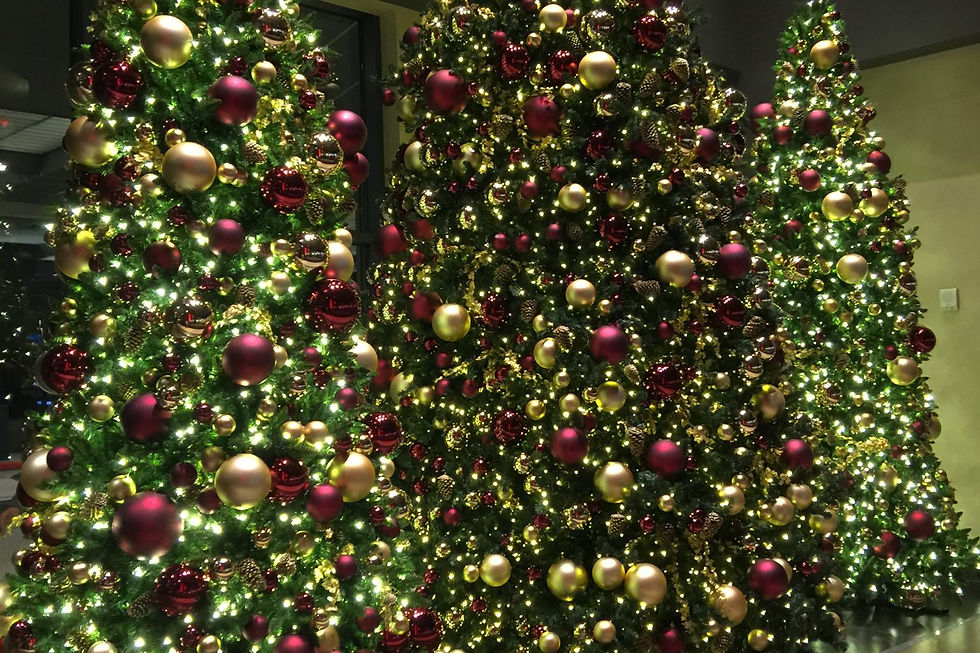
Indoor lobby trees vs outdoor giant trees
Indoor and outdoor trees solve different problems. Indoor trees need to fit the room and meet fire rules. Outdoor trees need to stand up to weather.
Factor | Indoor lobby or atrium tree | Outdoor giant tree |
|---|---|---|
Typical size | 7 to 30+ ft | 15 ft and up, often on a steel frame |
Main concern | Ceiling, clearance, fire safety | Wind, rain and anchoring |
Lighting | Warm white mini or LED lights in branches | Commercial-grade outdoor LED, often with a large star |
Base | Weighted stand, skirt or decorative planter | Ballast or ground anchors on a flat, solid surface |
Seen from | Close up, by visitors and staff | A distance, by drivers and passersby |
North Texas weather is the main outdoor challenge. Fronts can bring strong gusts, cold rain and the odd ice storm in the same season. Giant outdoor trees need to be anchored or ballasted for wind, with lights and décor fastened so nothing loosens.
Fire safety: flame-retardant materials and paperwork
Most U.S. cities, including those around Dallas-Fort Worth, adopt a version of the International Fire Code. Local amendments vary. In general, these codes limit natural cut trees in many public buildings and require artificial trees and decorative vegetation to be flame resistant.
Flame resistance for decorative materials is commonly tested to NFPA 701. Fire inspectors often ask to see proof. Use this checklist:
Use an artificial tree and décor labeled flame retardant or flame resistant.
Keep the certificate or test documentation on site and easy to find.
Use listed electric lights only. No candles or open flames on or near the tree.
Check with the local fire marshal or your building's fire safety plan before install. Rules differ by city and occupancy type.
If you want a live cut tree, confirm it is allowed in your building first. Many codes restrict them to sprinklered areas, and they need daily watering.
This is general guidance, not legal advice. Your local fire code and fire marshal have the final word.
Themes: ornaments, ribbon and lighting
A theme turns a tree into part of your brand. Keep it simple and repeat it in nearby wreaths, garland and planters so the whole space feels designed.
Classic: red and gold ornaments, plaid ribbon, warm white lights.
Elegant: champagne, gold and ivory with oversized ribbon.
Winter white: silver, white and clear ornaments with pure white lights.
Brand colors: ornaments and ribbon in company colors over warm white lights.
Natural: pinecones, berries and burlap for restaurants and rustic spaces.
Scale matters. Small ornaments disappear on a 20-foot tree. Large trees need oversized ornaments, wide ribbon and dense lighting to read from across the room.
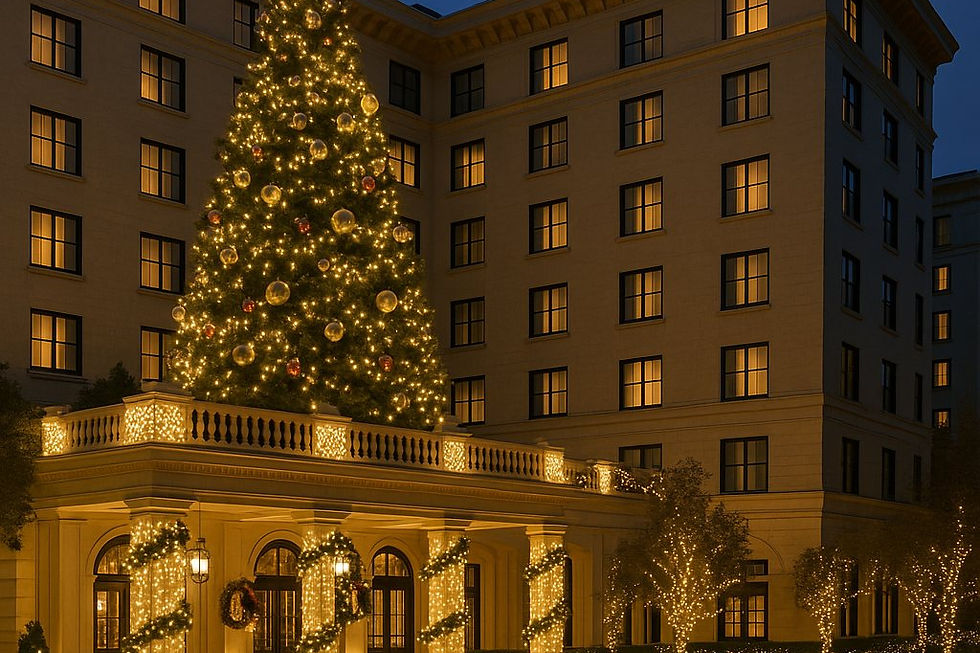
Install and removal logistics
Big trees take planning. Schedule install early in the season and outside business hours when possible.
Site walk: measure ceiling, footprint, door widths, elevators and power.
Design: choose tree size, profile and theme; confirm fire-safety paperwork.
Delivery: confirm loading dock, freight elevator and after-hours access.
Assembly: build and shape the tree, then add lights before décor.
Decorating: ornaments, ribbon, topper and skirt or planter.
In-season care: check lights and décor; respond to service calls.
Removal and storage: take down after the holidays and store until next year.
Our commercial holiday décor and Christmas tree service handles each step for offices, law firms, restaurants, retail, large venues and town offices across Dallas-Fort Worth. Pair the tree with exterior commercial Christmas lighting so the building and the lobby match. We carry liability insurance and workers' compensation, and certificates of insurance are available.
How tall should a lobby Christmas tree be?
Start with a tree about 2 to 3 feet shorter than the ceiling in a standard lobby. In tall atriums, leave more room for the topper and keep clear of lights, sprinklers and detectors. Also check the width so the tree does not crowd walkways.
Do commercial trees need to be flame retardant?
In most public and commercial buildings, yes. Fire codes commonly require artificial trees and décor to be flame resistant, often tested to NFPA 701, with documentation on site. Confirm with your local fire marshal.
Can a giant tree go outside in Texas wind?
Yes, if it is built for it. Outdoor giant trees use a sturdy frame, outdoor-rated lights and décor, and ballast or anchors sized for wind. Everything should be fastened so it stays put through gusty fronts.
How long does a commercial tree install take?
It depends on size and access. A small lobby tree can be done in a few hours. A large atrium or outdoor tree can take a full day or more, often after hours. Plan the date early in the season.
Who stores the tree after the season?
With our commercial holiday décor service, we remove the tree and décor after the holidays and store them. That frees your storage space and keeps the tree ready for next year.
Planning a lobby, atrium or outdoor tree in Dallas-Fort Worth? We will walk the property and send a proposal. Certificates of insurance available.


